Alright, let's talk speed. For any serious cyclist, the allure of a dedicated racing machine is, well, undeniable. It's more than just a bike; it's a finely tuned extension of your ambition, a canvas for your power, and, to be honest, a massive source of joy. If you're looking for professional racing bikes for sale, you've landed in the right spot. We're going to dive deep into what makes these bikes tick, what to look for, and how to snag a real winner.
The Current Pulse of the Racing Bike Market
The industry, you know, it's always evolving. We're seeing some pretty interesting trends right now. Aero bikes continue to dominate the top tier, with every manufacturer pushing the envelope on drag reduction. But, surprisingly, the demand for lightweight climbing bikes hasn't waned; riders still crave that feathery feel for ascents. And gravel? That's actually influencing road bike design, making some racing frames a bit more versatile than they used to be, which is a welcome change for many customers, I guess.
Getting Technical: What’s Under the Hood?
When you're eyeing a professional racing bikes for sale, the materials and construction are paramount. Most high-end frames are carbon fiber – a complex weave of fibers bound by resin, carefully laid up to optimize stiffness, compliance, and weight. Aluminum alloy frames, like the Racing Alloy Frame Bicycles Road bike, are still incredibly popular, especially for those looking for a robust, budget-friendly option. They're often hydroformed and triple-butted for strength where needed and weight savings elsewhere. Shimano, SRAM, and Campagnolo dominate the groupset market, offering everything from mechanical 105 to electronic Dura-Ace Di2, Red eTap AXS, or Super Record EPS.
A Closer Look at Frame Construction (The Nitty-Gritty)
Building a quality frame, whether carbon or alloy, is an art. For alloy frames, like our featured Racing Alloy Frame Bicycles Road bike, the process usually involves:
1. Material Sourcing: High-grade aluminum alloys (e.g., 6061 or 7005 series) are selected for their strength-to-weight ratio.
2. Tube Forming: Tubes are precisely cut, shaped (often hydroformed for aerodynamic or structural benefits), and sometimes 'butted' – varying wall thickness to save weight in low-stress areas.
3. Welding: Expert welders join the tubes. Quality welds are smooth, consistent, and crucial for frame integrity and service life.
4. Heat Treatment: Post-welding, frames are often heat-treated to restore and enhance the material's strength.
5. Finishing: This includes sanding, priming, painting, and clear-coating, protecting the frame and making it look fantastic.
Testing standards are rigorous. Frames often undergo ISO 4210 testing, simulating real-world stresses, fatigue, and impact. A well-built alloy frame, properly maintained, can easily offer a service life of 10+ years of enthusiastic riding, sometimes even more!
Product Spotlight: Racing Alloy Frame Bicycles Road Bike
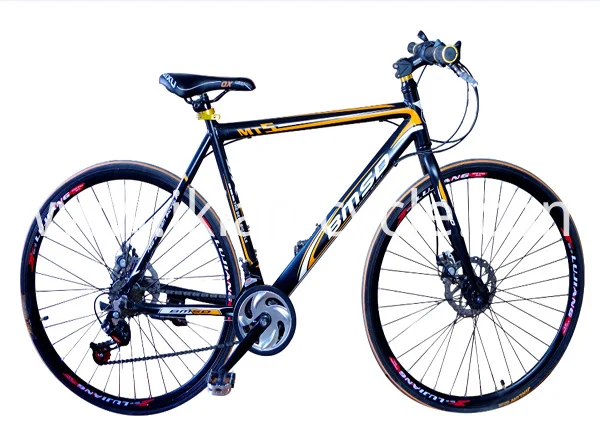
Let's take a moment to look at a solid option that many cyclists, myself included, would consider a fantastic entry point or a reliable training companion. The Racing Alloy Frame Bicycles Road bike from Ikia Tanda is, in fact, quite popular. Its focus on being a reliable, green, and economic means of transport speaks volumes. It’s colorful, which is a nice touch, and frankly, a comfortable handle grip and seat are non-negotiable for longer rides – they’ve got that covered. They even welcome OEM and ODM orders, which means you could potentially get a custom racing bike if you're a distributor. It offers great value, especially when considering the typical racing bike price points.
Key Specifications: Ikia Tanda Racing Alloy Frame Bicycles Road bike
Feature | Detail |
Frame Material | Aluminum Alloy |
Brake Type | V-Brake (typically, real-world use may vary) |
Grips/Seat | Comfortable (as per manufacturer description) |
Colors | Colorful options available |
Usage Scenario | Commuting, fitness, entry-level road cycling |
Customization | OEM/ODM welcome |
Choosing Your Weapon: A Quick Vendor Comparison
When you're comparing professional racing bikes for sale, it's not just about the price tag, is it? It's about reputation, innovation, and what kind of support you'll get. Here's a quick, generalized look at how various types of brands stack up. This should give you a better idea of the different racing bike types out there.
Vendor Type | Advantages | Considerations |
High-End European Brands (e.g., Pinarello, Colnago) | Cutting-edge tech, prestigious, top-tier performance, often lighter/aero. | Very high price, sometimes less practical for everyday use. |
Large Global Brands (e.g., Specialized, Trek, Giant) | Wide range of models, extensive R&D, strong dealer networks, good value at many price points. | Mass market feel for some, can be overwhelming choices. |
Value-Oriented Brands (e.g., Ikia Tanda, many direct-to-consumer) | Excellent racing bike price performance, accessible, reliable for training/commuting. | May not have the latest tech or lightest components, fewer customization options directly to consumer. |
The Road Ahead: Applications and Beyond
Who uses these bikes? Well, everyone from aspiring pros, weekend warriors chasing PRs, to commuters who just appreciate speed and efficiency. Advantages are clear: speed, efficiency, and direct power transfer. Surprisingly, many modern racing bikes, particularly those with a bit more tire clearance, are surprisingly good for long-distance endurance rides, not just crit racing. Customer feedback often highlights the thrill of a responsive bike and the importance of a comfortable saddle – something Ikia Tanda seems to prioritize.
Case Study: The Everyday Racer
Think about someone like Sarah, a busy professional who trains for local amateur races. She needs a bike that's fast enough for competition but also durable for daily training rides. A quality alloy frame professional racing bikes for sale, perhaps like the Ikia Tanda, with a solid entry-level groupset, fits the bill perfectly. It's robust enough to handle daily commutes, responsive enough for group rides, and affordable enough that a minor crash (hey, it happens!) isn't a financial catastrophe. It meets ISO 4210 safety standards, giving her peace of mind. That’s a practical win, if you ask me.
References:
1. Union Cycliste Internationale (UCI). Technical Regulations. (Authoritative standard for competition bikes).
2. Cycling Weekly. Latest Road Bike Reviews and News. (Industry trends and product insights).
3. ISO 4210:2023. Cycles – Safety Requirements for Bicycles. (International safety and testing standard).